Accurate Hot Selling MCPA-Level-1 Exam Dumps 2023 Newly Released [Q37-Q54]

5/5 - (1 vote)

Accurate Hot Selling MCPA-Level-1 Exam Dumps 2023 Newly Released

Get 100% Authentic MuleSoft MCPA-Level-1 Dumps with Correct Answers

QUESTION 37
A company wants to move its Mule API implementations into production as quickly as possible. To protect access to all Mule application data and metadata, the company requires that all Mule applications be deployed to the company’s customer-hosted infrastructure within the corporate firewall. What combination of runtime plane and control plane options meets these project lifecycle goals?


QUESTION 38
What condition requires using a CloudHub Dedicated Load Balancer?


QUESTION 39
What is typically NOT a function of the APIs created within the framework called API-led connectivity?


QUESTION 40
What should be ensured before sharing an API through a public Anypoint Exchange portal?


QUESTION 41
When using CloudHub with the Shared Load Balancer, what is managed EXCLUSIVELY by the API implementation (the Mule application) and NOT by Anypoint Platform?


QUESTION 42
The responses to some HTTP requests can be cached depending on the HTTP verb used in the request.
According to the HTTP specification, for what HTTP verbs is this safe to do?


QUESTION 43
What best describes the Fully Qualified Domain Names (FQDNs), also known as DNS entries, created when a Mule application is deployed to the CloudHub Shared Worker Cloud?


QUESTION 44
What best explains the use of auto-discovery in API implementations?


QUESTION 45
Refer to the exhibit.

Three business processes need to be implemented, and the implementations need to communicate with several different SaaS applications.
These processes are owned by separate (siloed) LOBs and are mainly independent of each other, but do share a few business entities. Each LOB has one development team and their own budget In this organizational context, what is the most effective approach to choose the API data models for the APIs that will implement these business processes with minimal redundancy of the data models?
A) Build several Bounded Context Data Models that align with coherent parts of the business processes and the definitions of associated business entities

B) Build distinct data models for each API to follow established micro-services and Agile API-centric practices

C) Build all API data models using XML schema to drive consistency and reuse across the organization

D) Build one centralized Canonical Data Model (Enterprise Data Model) that unifies all the data types from all three business processes, ensuring the data model is consistent and non-redundant


QUESTION 46
Refer to the exhibit.

A developer is building a client application to invoke an API deployed to the STAGING environment that is governed by a client ID enforcement policy.
What is required to successfully invoke the API?


QUESTION 47
What is a best practice when building System APIs?


QUESTION 48
Refer to the exhibit.

An organization uses one specific CloudHub (AWS) region for all CloudHub deployments.
How are CloudHub workers assigned to availability zones (AZs) when the organization’s Mule applications are deployed to CloudHub in that region?


QUESTION 49
Refer to the exhibit.
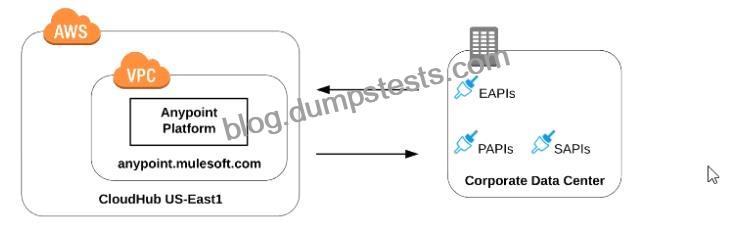
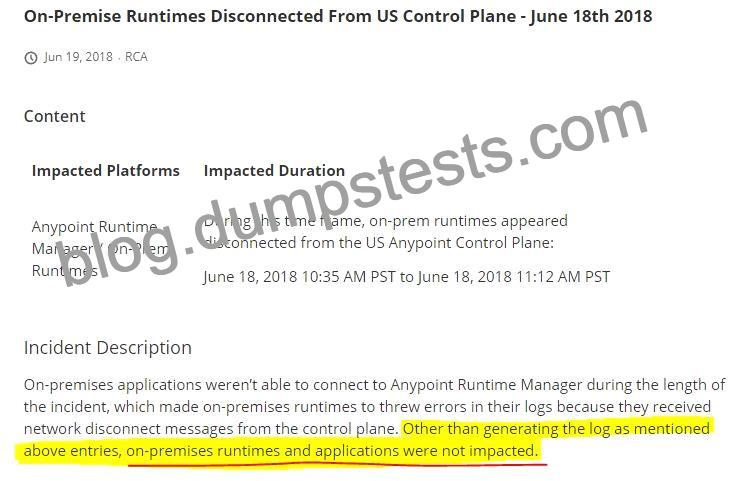
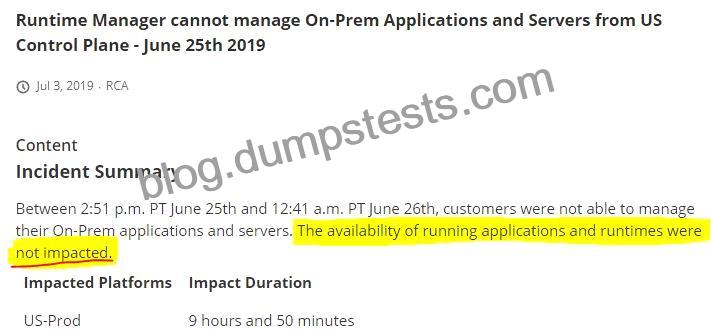
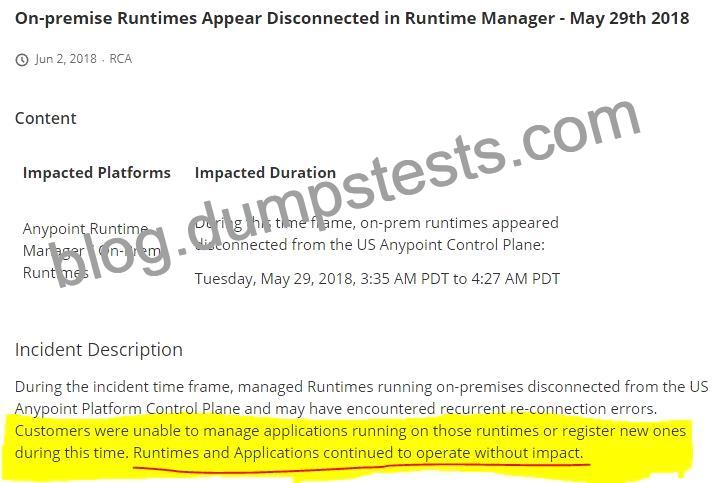
what is true when using customer-hosted Mule runtimes with the MuleSoft-hosted Anypoint Platform control plane (hybrid deployment)?


QUESTION 50
What CANNOT be effectively enforced using an API policy in Anypoint Platform?


QUESTION 51
An organization uses various cloud-based SaaS systems and multiple on-premises systems. The on-premises systems are an important part of the organization’s application network and can only be accessed from within the organization’s intranet.
What is the best way to configure and use Anypoint Platform to support integrations with both the cloud-based SaaS systems and on-premises systems?
A) Use CloudHub-deployed Mule runtimes in an Anypoint VPC managed by Anypoint Platform Private Cloud Edition control plane

B) Use CloudHub-deployed Mule runtimes in the shared worker cloud managed by the MuleSoft-hosted Anypoint Platform control plane

C) Use an on-premises installation of Mule runtimes that are completely isolated with NO external network access, managed by the Anypoint Platform Private Cloud Edition control plane

D) Use a combination of Cloud Hub-deployed and manually provisioned on-premises Mule runtimes managed by the MuleSoft-hosted Anypoint Platform control plane


QUESTION 52
What best explains the use of auto-discovery in API implementations?


QUESTION 53
What Mule application can have API policies applied by Anypoint Platform to the endpoint exposed by that Mule application?
A) A Mule application that accepts requests over HTTP/1.x

B) A Mule application that accepts JSON requests over TCP but is NOT required to provide a response

C) A Mute application that accepts JSON requests over WebSocket

D) A Mule application that accepts gRPC requests over HTTP/2


QUESTION 54
An organization is implementing a Quote of the Day API that caches today’s quote.


Dumps of MCPA-Level-1 Cover all the requirements of the Real Exam: https://www.dumpstests.com/MCPA-Level-1-latest-test-dumps.html

Related Links: myportal.utt.edu.tt myportal.utt.edu.tt www.stes.tyc.edu.tw myportal.utt.edu.tt myportal.utt.edu.tt myportal.utt.edu.tt

No Responses

Leave a Reply

Your email address will not be published. Required fields are marked *

Enter the text from the image below
 

Related Certifications
Recent Comments