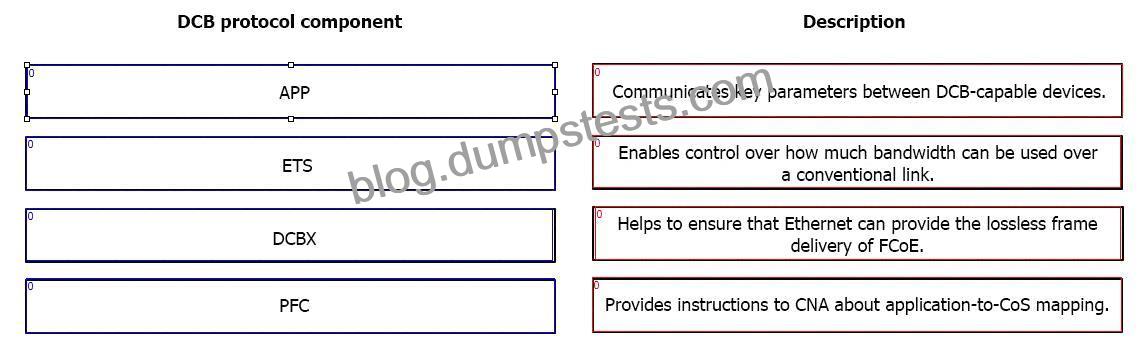
NO.52 Match each Data Center Bridging (DCB) protocol component with its description.
Explanation:
According to the Advanced HPE Edge-to-Cloud Solutions, page 98, the following matches are correct:
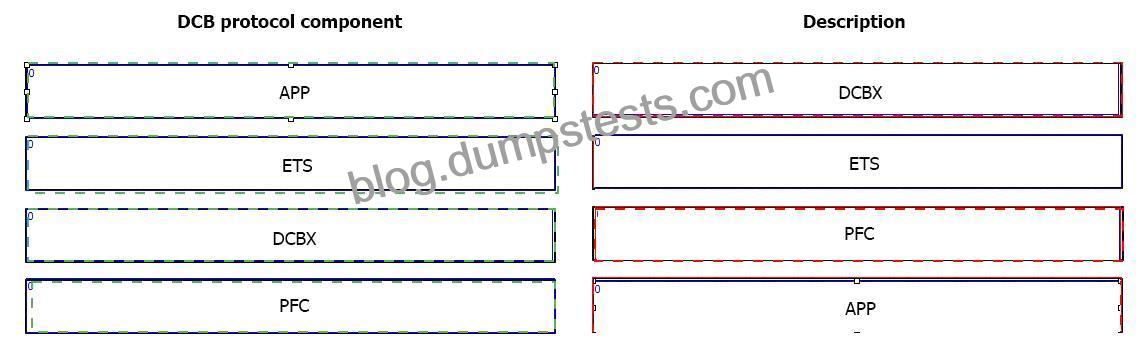
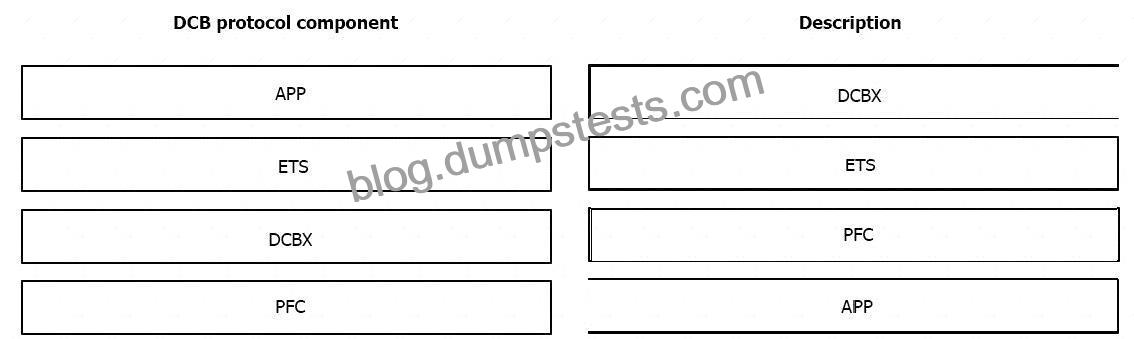
Communicates key parameters between DCB-capable devices. = DCBX
Enables control over how much bandwidth can be used over a conventional link. = ETS Helps to ensure that Ethernet can provide the lossless frame delivery of FCoE. = PFC Provides instructions to CNA about application-to-CoS mapping. = APP DCBX: Data Center Bridging Exchange Protocol. It is a protocol that enables the exchange of configuration and capability information between DCB-capable devices, such as switches and servers. It allows the devices to negotiate and agree on the parameters for the DCB features, such as ETS, PFC, and APP1.
ETS: Enhanced Transmission Selection. It is a feature that enables the allocation of bandwidth to different traffic classes on a link, based on the priority and the service level agreement. It allows the devices to control how much bandwidth can be used by each traffic class, and to avoid congestion and contention on the link1.
PFC: Priority-based Flow Control. It is a feature that enables the pause and resume of traffic on a link, based on the priority and the buffer availability. It allows the devices to prevent the loss of frames due to buffer overflow, and to ensure the lossless delivery of FCoE traffic, which requires reliable and in-order transmission1.
APP: Application Priority. It is a feature that enables the mapping of applications to traffic classes on a link, based on the priority and the quality of service. It allows the devices to instruct the Converged Network Adapter (CNA) about which traffic class to use for each application, and to optimize the performance and efficiency of the traffic1.


No Responses